
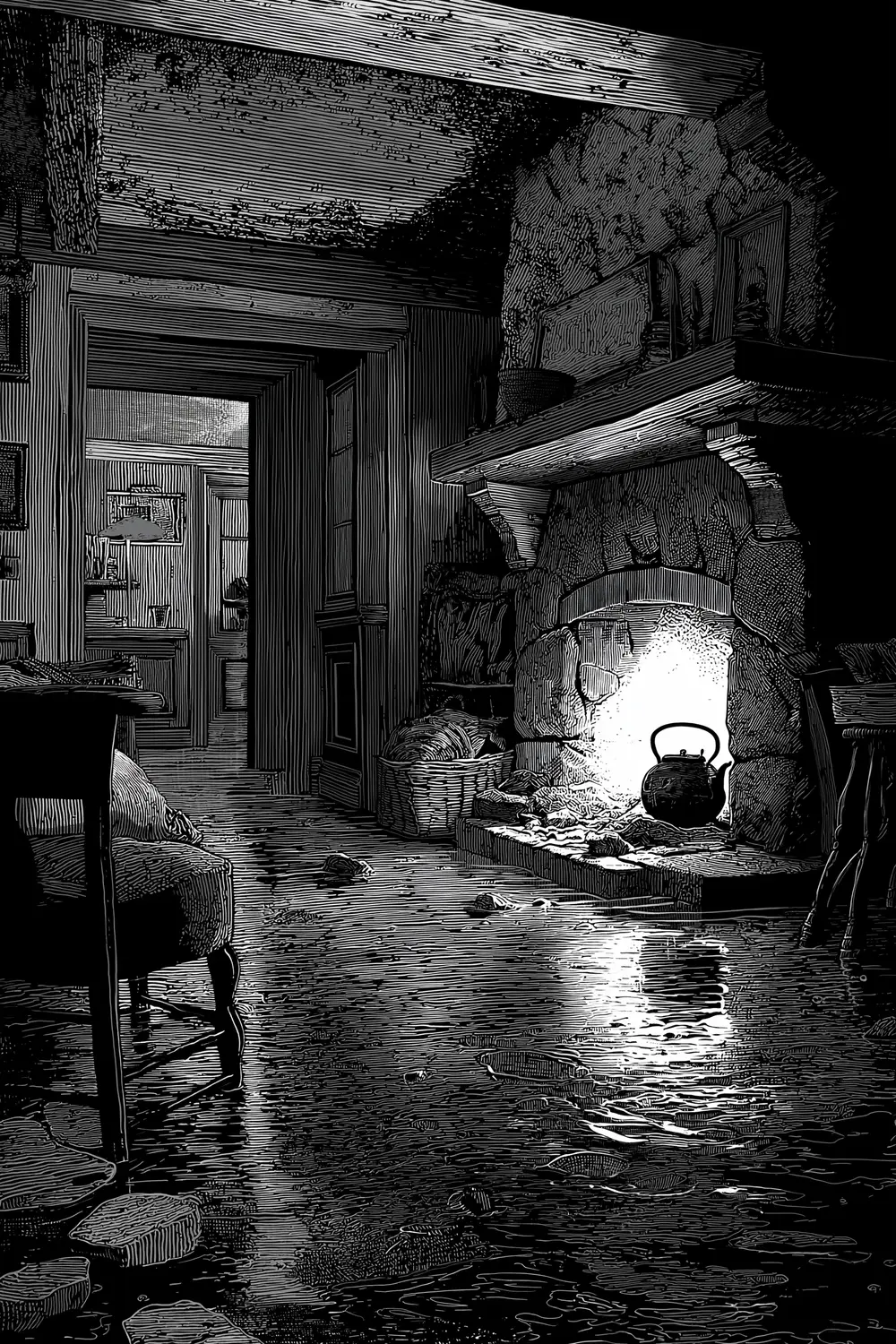
The Eastern Island of the Order of Protection
The Year of Our Lady Selnol the Ragged
Day the Fourth in the Season of Icewhile
Dawn had not yet broken, but a pale light was rising to lap at the brink of morning, and the stars were fading one by one. A single magpie could be seen in the blanching sky. Against the grey half-light, the black and white feathers seem incongruously vibrant.
The bird seemed to tear a path through the paper of the sky, leaving fleeting, wing-shaped impressions that were by turns pure black, pure white.
This island was ceaseless and horizonless, devoid of hills or mountains. One could travel across its entire breadth and length without encountering any sort of incline whatsoever, which was why travellers called it the flatlands, or by its ancient name, The Levelle.
The oldest stories about The Levelle spoke of a great demon who rolled the land out flat with his rolling pin and baked bread upon it, the crumbs of which became the first stars. These stories were not well remembered any more by the peoples of the land, and many had been forgotten entirely, along with the ancient songs, although the demons and wildfolk still knew them by heart.
In these days, the rulers of the Order of Protection placed a great deal of emphasis on peace and stability, and so the people of the Order of Protection did too. They worshipped the great orator God, Mooth, and considered themselves to be accordingly blessed in the gifts of speech and diplomacy.
By the year of Our Lady Antzuma, the Levelle was a nation of stability, well esteemed for its skills in peacekeeping and reconciliation, with ambassadors and advisors well established in almost all corners of the world.
When the fourth day of winter finally broke, the morning light spilled out from its bowl in the sky and touched a wild corner of the island where the young crown prince Leif Berranek was journeying. His hair, when the light touched it, was as pale as boneflower; his eyes reflected perfectly the grey weight of the dawn sky and seemed to hold no colour of their own at all. They were bright with that peculiar, luminous quality that is often seen in the eyes of sleepwalkers or people who are not quite well—pensive and dreaming by turns, gazing at nothing and everything. Now his face was quite calm and composed, although his eyes glimmered with the unsteady quality of starlight.
Although his complexion and bearing were princely in the highest degree, his dress was somewhat peculiar. He wore the garb of a hunter, although it looked uncomfortable and ill-fitting on him. His plain hide armour had an enchantment on it that had either been diluted to start with or had faded with age: it glowed queasily in the gloom with its own faint, greenish light.
His boots and gloves were made of dog-skin, and at his side hung an unadorned silver sword with the symbol of the Order of Protection at the pommel. Then, alongside these unremarkable—some might even say unprincely—articles of equipment, he wore an ostentatious filigree crown that had been delicately moulded out of real lumin, and adorned with diamonds. The prince’s initials, LB, had been written out in opals at the front, so there could really be no question of his identity, even though a glance at his features was sufficient to mark him out as a son of Queen Berranek. This crown sat like a beacon on the young prince’s head, glittering his family connections out into the world for all to see. Inexplicably and despite its worth, it held no powers or enchantments whatsoever—neither could it be of any use as an actual helmet, being as delicate and light as a sugar decoration on a wedding cake.
This was certainly a strange state of affairs, given the dangers of the wild territory that the Prince found himself in, which was home to more demons than humans, and was far from the protection of the castle. Prince Leif himself appeared unperturbed as he stood gazing westwards towards Wuulwemul with a mild, thoughtful expression.
He was not far now from the Mirror Grotto—the lair of the demon Rojin and the great store of treasure that it hoarded there. Among the riches, fiercely guarded, were rumoured to be a number of Divine Relics—the name given in that land to items bestowed with rare and mysterious power. The prince himself, it should be mentioned, was in possession of one such Divine Relic, which had been bequeathed to him by the Queen Antova on the day he came of age. It was an Amulet of Protection; a golden locket in the shape of two cupped hands that hung on a golden chain around Leif’s neck. This amulet, contrary to its name, did not afford the young prince any form of protection at all, but was blessed with the curious trick of being able to magic into existence an endless supply of seeds of the royal tree of the Order of Protection. The existence of this Divine Relic and its possession by the royal family of the Order of Protection perhaps explained the family’s ancient pledge to shade the land and feed the people, which the holding of this relic neatly fulfilled.
Prince Leif unclasped the locket now, and although the amulet would not have rattled had it been shaken, a small reddish-brown nut now sat in the hollow of the golden hands. He stooped to plant it in the soil at his feet.
Royal pledge fulfilled, the prince straightened to gather his knapsack, but stopped when he saw the magpie. It was perched on a low branch of a nearby lanya tree, and although it had been assiduously wiping its beak on a cluster of leaves before, it now stopped as if embarrassed, and, turning its head aside, looked narrowly at the prince with one bright berry-black eye.
“Good morning, master magpie!” said Leif, mostly to himself. It was considered good luck on the island to greet a magpie when you saw one—this was an old folk tradition, the origins of which had been lost to time.
The magpie ignored him. It was looking at his crown now. It turned its head to the other side in order to assess the sparkling edifice more properly with its right eye, and then cocked its head again to inspect it with the left. It craned its neck to get a better view. It leaned forward on its branch and stared, its beak slightly open and its eyes bright with diamonds, until Leif broke out laughing.
This startled the bird briefly into flight. Its stammering wingbeat tattooed the air between them, blinking in rapid bands of black and white as it retreated to higher ground. The effect resolved when the bird landed in the velvet shade of the lanya tree’s upper branches.
“Sorry,” Leif said, still half laughing. “Aren’t you beautiful! What would you like?”
The magpie peered down at him.
“Would you like something to eat? Here, have this! And keep me from bad luck, won’t you?” Smiling, he took a second nut from the little golden amulet and tossed it to the ground beneath the tree.
The sun was high enough now to travel by; he would easily reach the Grotto by evening. There was treasure to be retrieved and a powerful guardian to be reckoned with—and if the demon Rojin was as fierce as the stories suggested then Leif would need all the good luck he could get.
If the thought of this coming battle troubled him, it did not show. The young Crown prince, as he wandered westwards, could be heard singing a hymn under his breath. His eyes were the colour of the wide sky and his expression was mild and far-off, as if he were remembering a place from his childhood as he sang:
Veil thee with many veils,
It hideth not your fire
But rouseth thee to bright desire
To speak thy sacred tales.
The pale sun continued to rise; the air was quite still and cold.
Back at the lanya tree, a faint clapping of wings could be heard as the magpie flew to the ground. Somewhere between the sky and the earth, it found a new shape and became something else.
In the deep shade at the foot of the tree stood now the demon Rojin, dressed in a cloak of dark and pale feathers.
The demon stooped briefly, and when they rose they held between their thumb and forefinger a nut of the royal tree of the Order of Protection. They held it up to their black eyes and examined it closely. They looked at the retreating shape of the prince in the distance, and smiled hungrily, showing all of their teeth.
Very little was known about the Mirror Grotto, a little observed Wonder on the South stormshores of Juwnedon-Wek, partly due to the wild remoteness of the region and partly due to the density and great variety of the demon population there, who deterred most travellers and ate the rest.
The earliest historical account of the place is also the most detailed—a short passage in Phasros the Elder’s Vestigo, reading:
“Of the so-called ‘Grotto of Mirrors’ near Ninnolzhew, which may be the same wonder as the Knoll of Bones, it is said to be a demon-made construction taking the shape of a low hillock upon the landscape, the inside of which is lined with splendour and the outer with gore.”
Most later texts do not mention it at all, although there is an old song of that region which praises “yon shyning hill of bones,” which likely refers to the place, there being no real hills or mountains in that region at all. It does not feature on the majority of maps, lacking the extraordinary usefulness of The Exalted Basin, or the tragic history of The Exalted Maple.
How Prince Leif Berranek had managed to make it there unscathed was anyone’s guess. His armour was mismatched and poorly made, his sword was dull, and yet he carried with him an astonishingly rare map from the library of the royal family, printed on demonhide. This map, strange to say, had been gifted to him personally by the very same royal personages who had seen fit to send him out into the world wearing dog-skin gloves.
The map depicted the island in wonderful detail, accurately charting a number of regions that were thought to be entirely uncharted, among them Juwnedon-Wek, the Order of Protection’s principle island.
The map had been marked for him to show the rumoured locations of a number of Divine Relics—those rare and curious pieces of equipment that were coveted by all those who sought power, and which granted their bearers strange, wonderful gifts.
Prince Leif stood just a few paces now from the Grotto, dressed in his strange garb and bejewelled crown. He consulted the demonhide map one last time. The Mirror Grotto was depicted as a low mound, with a small golden X painted to indicate the presence there of a possible Divine Relic. In black ink above the mound was another tiny symbol—a six fingered hand, the mark used to denote the presence of a great demon.
Leif put the map away and looked the grotto. Phasros the Elder’s Vestigo and the map had both depicted the grotto as a sort of hillock, but both sources were ancient. The Mirror Grotto had grown since those days, now jutting up into the sky like a pale skeletal thumb.
It had looked uniformly white from a distance, but now that he was closer, Leif saw the innumerable bones, skulls and ossicles that had been picked clean and pressed into the walls of the structure. The bones near the bottom of the towering structure had been bleached white in the sun, but those nearer the top were newer, and were dark with blood. Above, a magpie circled.
No demon came to tear him limb from limb as Leif approached. No challenge answered his tentative, questioning call. Still, it was with great trepidation that he entered the grotto, almost holding his breath as he stepped through a doorway that no living creature, save the demon Rojin, had passed through for centuries.
It was cool inside and quite silent. The high walls reached up to an open circle of sky far above through which the light poured in, breaking itself on the way down into a thousand points of brilliance, for the walls of the grotto were lined with glittering treasures from the floor to the ceiling.
So kaleidoscopic and dazzling was this effect that it took some time for Leif’s eyes to adjust, and then with a racing heart he stepped further in and gazed around in search of something resembling a Divine Relic. Here, he began to have his first misgivings. On closer inspection, the items lining the walls did not appear to be treasures at all, but rather a large collection of carefully curated pieces of rubbish.
There was a pair of broken spectacles with a crack across one of the lenses. There were innumerable pieces of magenta and turquoise coloured glass—the hues commonly used in that region for ale and rootwine bottles. There were shards of mirrors, entire hand mirrors, wall mirrors, and—Leif shuddered to see—hundreds upon hundreds of traditional handheld demon-glasses. These relics were commonly carried by villagers and poorfolk and consisted of a piece of smoked mirror set in a little embroidered frame at the end of a stick—it was believed that they warded off demons.
They clearly had not warded off the demon Rojin, who had plucked these mirrors from the bodies of the villagers, and had been setting them in the walls of the grotto for centuries. The demon-glasses nearer the bottom of the walls were quite ancient: their mirrors hexagonal instead of circular. The surfaces of the mirrors were engraved with words in the old language, a practice which had died out more than two hundred years ago.
Leif stood on tiptoe and craned his neck to get a better look at the items higher up. Beetle wings; tin foil; silverware; what looked like a great cracked lighthouse lens. And as he stared in growing dismay, a dark shadow fell across the entrance to the grotto.
There in the entranceway stood the great demon Rojin themselves. They had taken the form of a giant magpie, so large that their head would not fit through the doorway of the grotto. They stooped and pressed their enormous eye against the entrance, peering in.
Leif, trembling from head to toe, drew his sword and promptly dropped it. “Whoops,” he said.
“Well, well, well. What do we have here?” said the magpie, in a great croaking voice like a cracked bell. The demon’s eye nearly filled the doorway.
Leif hastily backed himself up against the furthest wall and tried to think of something to say. “I am Prince Leif,” he said at last, for it seemed as if the magpie really was awaiting an answer. “Prince Leif Berranek, of the royal house of the Order of Protection.”
“A prince!” The eye scrutinised him in silence for a bit.
“I like your grotto,” said Leif, weakly.
“Do you?”
“Oh, yes! Yes . . . there’s ever such a lot here, isn’t there? Gosh. And er, the decoration. Is it all . . . er . . . this sort of thing?”
“What sort of thing?”
“Bottles? Bits of glass and such?”
The eye at the entrance narrowed.
“Well!” said Leif, nervously. “It’s all marvellous, I must say. Jolly good stuff. Lovely bottles.”
“I collected it all myself.”
“Goodness! Well! My word!” Leif cleared his throat awkwardly. “Is—is there anything more powerful here, perhaps? My map said there might be—”
“I have spec-a-tacles,” said Rojin modestly. “Many pairs. Human made.”
There was a pause.
“Do they—are they—do they have any sort of, er, powers?”
“Light catching,” said the magpie. “They catch the light. Look!”
Leif looked, dutifully. They did, indeed, catch the light rather nicely, but it was becoming evident that there were no Divine Relics to be found in this place. Rather, it seemed as though Leif had entered the lair of a demon that had been killing humans for centuries for their sparkly things—at which point he abruptly realised he’d entered its lair wearing an incredibly sparkly crown.
He straightened it now, nervously, and watched the enormous demon eye track his movement. As they continued to speak, the eye remained fixed on the crown.
“Are there any more of those seeds left?” said the giant magpie, conversationally.
“P-pardon?”
The demon turned, and poked their enormous, sharp beak into the entrance of the grotto. The beak was long, but not quite so long that it could reach Leif, pressed as he was at the furthest end of the grotto with a collection of cracked pince-nez digging into his back.
“DO YOU HAVE ANY MORE OF THOSE SEEDS LEFT?” the beak asked, very loudly.
Leif stared blankly—for a moment he could not make the slightest sense of the question. Then he remembered. “Are—are you—the magpie from earlier?”
“Yes,” said the magpie from earlier.
“And—” Leif hesitated, thrown into sudden doubt. “—You are the demon Rojin, are you?”
“Yes,” said the demon Rojin.
The beak was very alarming to look at, this close. It was as black and wicked as a flint’s edge. When it opened to speak (which was also alarming) it revealed a sharp looking tongue, as black as onyx. “The seeds,” the beak prompted.
“Oh! Yes! I have more,” said Leif. “Many more. An infinite supply. My amulet can make them.”
Rojin removed their beak and pressed their eye to the entrance again to have a good look at the amulet.
Leif could see himself reflected in the great oil-dark eye. He looked very anxious. He tried to make himself look less anxious by putting one hand on his hip in a nonchalant manner, but the results were mixed.
“Did you say infinite?” asked Rojin.
“Yes,” said Leif. “Infinite.” And then, remembering the razor-sharp beak, he added hastily, “but only I can operate it. Th-there’s a knack, you know. So, you wouldn’t want to kill me for it.”
“No,” said Rojin, rather vaguely. The eye was so large that it was hard to know whether it was staring at the crown, the amulet, or Leif himself.
“No,” said Leif, firmly.
“Give me one”, said Rojin. They thrust their beak back through the doorway.
Leif looked doubtfully at the beak. “Well . . . alright. I was just thinking, perhaps, if you did have an item of power around here, perhaps you might consider trading it for some seeds?”
The beak opened as much as it could in the low entranceway, which was not very far. “Ahhh!” the beak said, expectantly.
Leif unclasped his amulet and rather gingerly placed one of the acorn-sized seeds into the open beak. The beak clacked shut and withdrew. There was a pause.
“WHATTTHATATTTTATT?” roared the demon Rojin, in a voice like ragged thunder.
Leif eyed the open doorway in alarm, through which he could just see a pair of enormous black, scaley bird legs, and the white feathered underbelly of Rojin. If he ran now—if he ran quickly and darted out of the way, perhaps he could escape?
But before he could put this thought into action, Rojin had put their eye to the doorway once more. The eye looked annoyed. “That was TINY. What a tiny little seed. Where are the big ones you gave me earlier?”
“Th-these are the same ones,” said Leif, faintly. “There’s only one kind. They’re from the royal tree.”
“What?” cried Rojin. “Where are you hiding them? Where? Why? Give me one!”
“You were much smaller earlier,” offered Leif, timidly.
There was another, much longer pause.
“I know that,” said Rojin, haughtily. “I was much smaller earlier. Yes. I was in my smaller magpie form, wasn’t I? Yes.”
The monstrous form at the entranceway seemed to fold itself inwards somehow as if a drawstring were being pulled, and Rojin, in the form of a little magpie, hopped pertly into the grotto. Leif, who had come forward a little bit, shrank sharply back against the wall again.
“Give me another,” cried Rojin. “It wasn’t as good when my beak was big. It tasted very small. I’ll have one in my small beak instead.” They opened their small beak, demonstratively.
Leif wondered whether he should place a seed directly into the beak, or whether that might be presumptuous.
“Wait,” said Rojin, and rose, and grew, and in a sudden was in human form, in their cloak of black and white feathers. Their eyes were very bright and very black, just as the magpie’s had been, but were far more expressive, and regarded Leif with much curiosity and interest.
Leif, for his part, was quite speechless, having never seen a demon change forms before, and having not expected such a very human-looking Rojin to approach him with hand outstretched.
Rojin’s face—their human-seeming face—was a remarkable one. They wore stripes of black and white face paint, white beneath the eyes; black beneath the mouth. In their face there was a suggestion of immense pride and cruelty, but at the same time something confiding and very full of simplicity. The contrast was what struck Leif at that moment, as opposite as the black and the white feathers. The overall effect was unusually lovely, a very strange beauty—Leif opened his mouth to speak and could not think of a single word to say.
“I’ll try one in this form,” said Rojin. They were standing far too close. “Please.”
Wordlessly, Leif unclasped the golden locket, took out another seed and dropped it into Rojin’s open palm.
The demon tossed it into their mouth at once and crunched it rapturously. “Wow,” they said. “Wow. Wow.”
“Good?”
“Good. Very good. Yes. The raiment, the gifting. So far, very much.”
Not knowing quite what to say to this but observing that he did not appear to be under any immediate threat from the demon, Leif said, “About that trade . . . ”
“There are more seeds?” said Rojin.
“Yes, of course.”
“More seeds for me?”
“Well.” Leif faltered. “If . . . if . . . ”
“You are good,” said Rojin, nicely. “You are very nice.”
“Th-thank you,” said Prince Leif.
“Do you suppose,” said Rojin, “that I could have another seed?”
“Could I have a Divine Relic in exchange?” said Leif, bravely.
Rojin parsed this for a moment, then leaned in without any hesitation whatsoever and kissed him. It was a keen, thoughtless, fleeting kiss—and it was the first time that anyone had ever kissed the Crown Prince Leif Berranek, although he was almost twenty eight years old.
“Ah,” said Leif.
Rojiin looked pleased. They looked at his dog-skin gloves and his patched boots, his glowing armour, his golden locket and his sparkling crown. They looked at his wide, pale eyes and his parted lips and his wheat-coloured hair. “Would you like another?” they asked.
Leif appeared to be struggling with how best to answer this question. “That’s all right,” he said at last, with some effort. He gazed at Rojin, lost for words. At first, when the demon had come up so close to him, he had become as pale as death; but now the blood had rushed back to his cheeks. “The thing is . . . I was actually—I was looking for items of power, you see. There may have been a misunderstanding.”
“Items of power?” Rojin cocked his head to one side. “Afbrigði?”
“Pardon?”
“You’re talking about the calamities, aren’t you? Afbrigði. Calamities. The singing swords and the burning cloaks? The little bits of talking jewellery?”
“Yes!” said Leif, excitedly. “That’s them! Only, we call them Divine Relics!”
“What?” Rojin rather unexpectedly burst out laughing. “You call them the same word as a kiss! How funny you humans are! Ha! Ha! Ha! A kiss, I like that!”
“Oh,” said Leif, blushing again. “Well. We don’t exactly—”
“I understand,” said Rojin, serenely. “You like the calamities. You’d like some for the nest?”
“The nest?”
Rojin gestured around them at the grotto. Seeing Leif’s dumbfounded expression, they added hastily, “It’s not finished yet, of course. It could go much higher than this. This is just for starters. Lots of room for Afbrigði.”
Leif gazed around, distractedly. He looked rather flustered—his blush had not disappeared yet and he spoke quickly and self consciously. “So, there are none here? Well, that’s alright. I’m on a mission, is all. It isn’t going very well so far. I’m supposed to collect them up, as many as I can. They’re dangerous, you see. I’m not surprised you call them calamities in your tongue! Well. I’m to send them back to the castle to be destroyed. It doesn’t matter that there aren’t any here though, after all. Hey ho! It was only a rumour. Still, I thought that Dread Grasp might be here.”
“Never heard of it,” said Rojin.
“You’ve never heard of Dread Grasp? The gloves of protection?”
“Never.”
“What! You must have! Dread Grasp! From the song?”
“Not at all! What song?”
“Grasping the heart of forgetting,
Holding firm the threads of dream,
Gath’ring the stems of oblivion
Stitching closed the broken seam”
Leif paused, embarrassed. His voice, as clear as birdsong, rang out against the eyeglasses and the mirrors and the broken bottles. “It’s about a pair of gloves,” he finished shyly, aware that Rojin was staring.
“That is a human song, I think. Could I have another seed?”
Leif gave them one. The demon ate it very slowly and consideringly, looking at Leif all the while with their bright, dark eyes. When they had finished it, they said, “I accept.”
“You do?” said Leif. Then, “Accept what?”
“The gift was good. Very good. I like the gifts very much. I like very much that there is an infinite supply of gifts,” said Rojin. “I liked the song very much, also. Yes. The crown is precisely to my liking. I like you very much, Prince.”
Leif looked at the demon gravely for a moment, as if he were unsure whether he were being teased or not. But seeing that Rojin’s expression was quite as serious as his own, he suddenly broke out smiling.
“Oh! I think I like you too, Rojin. You are not at all what I thought you would be. I am a great believer in destiny—I don’t know if demons believe in a thing like that, but—that is—it seems as if we were supposed to meet. I had a strange feeling when I first saw you. I almost felt as though I knew you or as if I had seen you before. In a dream, perhaps?” He stopped, confused.
Rojin looked at him inquisitively but did not laugh.
“And you could help me collect Divine Relics, you said? That’s the very thing I’ve set out to do!”
“There are no Afbrigði here,” the demon said. “But if those are what you like, I shall help you get some. Yes! In return for your song and your gifts and your raiment. And then you’ll see how powerful Rojin is! A strong bird! A builder of tall nests!”
“Is that so?” murmured the prince, a little nonsensically.
“You don’t have to decide now, of course,” Rojin said hastily. “Three moons is traditional. You can wait. You can see.”
“I see,” said the prince. “And—after three moons?”
Rojin placed Leif’s hand into their own and laced their fingers together, six against five. “We can marry!”
Six fingers interlaced with five.
Leif opened his mouth to speak, not quite knowing what he would say, when he was interrupted by a booming voice from outside the grotto. “Human! Come, face me and meet your death!”
The voice was so loud that it made the mirrored walls shiver. An eyeglass was shaken loose from its moorings and fell to the ground, smashing into pieces. Rojin gave a squawk of indignation as they rushed over to it and became almost immediately absorbed by the task of picking up the shards. They crouched, their cloak of feathers spread out around them, and gingerly began sorting the shards into five little piles, according to a series of criteria that were apparent only to them.
Leif, still stunned at Rojin’s proposal, dithered for a long moment before he picked up his sword and peered cautiously outside the entrance.
Outside stood a monstrous toad demon, as tall as a hawthorn bush. He was dressed in the traditional winter garb of his kind: a thick, ornately embroidered robe of living moss fastened up to his yellow throat with carved acorn buttons and a cap of mouse fur. His enormous eyes, as pearlescent as two liquid opals, held sideways pupils within their depths which widened when they landed on Leif.
“Aha!” the toad boomed. “So, the rumours are true! How the willows touch the waters, eh? Ha! I have come to slay you, Little Prince!”
Leif readied his sword, and immediately dropped it. “Whoops!” he said. Then, “What rumours?”
“An unprotected little tadpole, sent into our depths! How the bubbles rise!” The toad flicked his moss robe aside, revealing his weapon of choice hanging at his hip—a large and ornate flyswat. He brandished it menacingly. “A little royal gift, eh? A little offering from the Order of Perspiration!”
“Protection!” said Leif, rather hotly. He picked the sword back up and waved it about thoroughly. “My family serves the Order of Protection.”
“That’s what I said. All those human orders, they’re all the same thing really, ain’t they?”
“No,” said Leif, indignantly. He gave the sword another good wave about. “And I’m not a gift! I’ve been sent out on a mission, as it happens. An important mission! Not that it’s any business of yours!”
“That’s not what I’ve heard. How it all ripples out, eh? I’ve heard they want you dead!”
“What?”
“Dead!” The toad raised the huge flyswat above his head. “Say your prayers, Little Prince! The pond shall dry around you!”
Leif, seeing that a conflict was inevitable, squared himself. He pointed the sword directly at the belly of the toad demon and held himself quite still. The blade was heavy and dull, but the clouds had parted and a thin beam of winter light seemed to strike its edge just so and set it gleaming. A feeling of great dread and heaviness seemed to settle on his heart, but with it came an intense stillness—and below the stillness, the sense of something unseen, tumultuous, seething below the surface somewhere.
But rising.
At this moment, Rojin stuck their head outside of the grotto. “What’s all the racket?”
“Rojin!” said the toad. He lowered the flyswat.
“Oh! It’s Nigel! Hello, Nige! How are the kids?”
The toad demon touched a great webbed finger to the brim of his fur cap. “How do! Didn’t think you was home! Look what I’ve caught!” He gestured affably to Leif. “A little snack! Want some?”
“Oho! Watch yourself! That little snack is my fiancé!” Rojin said. They hopped out and came to stand next to Leif, their chest puffed out with pride.
Leif lowered his sword at last, his heart pounding. The strange, still feeling had broken with the moment and disappeared.
“This little snack’s not for eating!” he said, pointing to his chest. He wished that something a little more impressive had come out, but there it was. He continued, hurriedly, “And it’s got no quarrel with you! I mean—I’ve got no quarrel with you.”
“Goodness!” said Nigel, peering down at him. “Well! How the lily drifts! Fiancé, is it? You and Rojin—undecideds?”
“That’s right,” said Leif.
“It’s true!” crowed Rojin.
“A human fiancé! Well, I never! And a royal to boot! Well, Rojin, it’s about time! Congratulations! Ha! Ha! Ha! And here’s me about to make a little elevenses of him! Ent it lucky I didn’t swallow him up, eh?”
Both Rojin and Nigel laughed heartily at this thought—even Leif joined in, although a little uneasily.
“Apologies, Prince Leif,” said Nigel. “I had no inkling you was associated with Rojin. As the rushes bow to the wind, I hope you’ll forgive me.”
“Think nothing of it,” said Leif. He was rather struck that Nigel appeared to know his rank, and even his name. “Have you heard of me, then?”
“Oh yes, yes,” said Nigel, with a careless wave. “Well now, you absolutely must come and meet the missus! And the little hoplings have been asking after you, Rojin! Won’t you both come for a spot of supper?”
“The thing is,” said Leif, a little timidly, “I’m on a mission. I haven’t found a single Divine Relic yet, and I really should try and find just one, just to get started.”
“Leif’s looking for calamities,” said Rojin, cheerfully.
“Is that right? Ent you humans funny! Well, why not ask my ma about them? She’s lived round these parts for over a thousand years—if anyone knows about Afbrigði, it’ll be her! Come, she’d love to meet a human! And Rojin’s undecided, to boot! You must come! Say you will!”
And so, they went.
It was not a long walk. Nigel lived beside a pond nearby, not more than a couple of miles away, so he led the way and was very talkative, entering into a lengthy monologue about his family history, which could be traced back over fifty thousand years. Leif and Rojin walked behind a little ways, listening. They were a little shy with one another and did not speak very much at first.
“It’s good you didn’t kill Nigel,” Rojin offered, at length.
“Yes!” said Leif. “Yes, that would have been awful, wouldn’t it?”
They walked along a little more in silence.
“I’ve never been betrothed,” Leif blurted out, unexpectedly. “My family didn’t think it was proper, what with my constitution. I have the falling sickness, you know. I’m much better with it now, but—well. I thought you should know. I was unwell for ever such a long time, as a child. They sent me away to the seaside for many years, for the good air, so I really haven’t seen much of the world. I’m a little stronger now, and better, and I haven’t had a fit for many months. But I did think you should know. In human circles, at least, I have not been judged to be suitable husband material. And I would hate to mislead you. And I would understand completely if you withdrew your proposal.”
Rojin stopped dead. “What?” they said, aghast.
“I know,” said Leif, miserably. “I can’t apologise enough. I would have said so at once, but we were interrupted.”
“This is quite wrong,” said Rojin, seriously. They put a hand on Leif’s shoulder and looked hard into his eyes. “You are very fine husband material. Understand? Very fine. Who has told you this thing?”
“I have the falling sickness,” Leif repeated. “I have fits, sometimes, Rojin. I’m afraid I’m not well.”
Rojin stared at him in disbelief. “Not well? Many of our finest shamans and witches have this gift! What’s it to do with being a husband?”
Leif stood mutely for a moment, twisting his hands together. “I’m not very strong,” he offered, at last.
“That’s alright!” said Rojin, brightly. “I’m very strong! Strong enough for both. Anything else?”
“I might be unwell, sometimes,” said Leif, very quietly.
“So might I be!” said Rojin. They patted Leif’s shoulder. “Everyone gets unwell sometimes! I’ll look after you, and bring you little mirrors if you like. Would you like that?”
“Yes,” said Leif, thickly.
“What! Are you sad? Oh, dear! Are you crying?” In their alarm, Rojin flew into their small magpie form, up to Leif’s shoulder, to his crown, to his other shoulder, fluttering their wings in agitation.
Nigel came back along the path to see what was happening. “Deary dear, what’s all this then?” he asked when he saw Leif’s face. He patted his pockets and pulled out a large green handkerchief. “There, there, little human,” he said. “Are you sad about . . . ” He paused, consulted his knowledge of humans, and hazarded a guess, “weapons?”
Leif could not immediately answer.
“You’ll have lots of weapons soon, I expect,” said Nigel, soothingly. “Lovely big swords and things. You’ll like that, won’t you?”
“I don’t know why he’s sad! He was only telling me he has seizures,” said Rojin, greatly perplexed.
“Well! A real all-rounder, isn’t he?” said Nigel. He looked at Leif with renewed respect. “You’ve done well for yourself there, Rojin. Now, what are you crying for, eh? What’s the matter?”
“I’m happy. I’m just happy.” Leif rubbed his eyes with the back of his sleeve.
Rojin flew into their human form in order to peer closely and anxiously into his face. “Yes! He’s just happy!” Rojin announced with great relief.
“Goodness me! You young things! All sunshine and storms, eh? Come on, it’s not far now. Ma’ll have tea on.”
Leif and Rojin walked hand in hand the rest of the way.
Soon they reached the toad demon’s dwelling, which was set below ground in a hollowed out burrow beneath an enormous boulder. The boulder was set at the edge of a fishpond and stood many spans high. It was covered from the bottom almost to the top with the painted outlines of many hundreds of webbed hands in varying shades of green and yellow paint.
“My ancestors,” said Nigel proudly, seeing Leif’s interest. He stooped and pointed at some of the faded handprints at the bottom of the boulder. They were much larger, and the webbed fingers had the suggestions of talons at the ends.
“Periphemus the net-weaver,” he said, modestly. “Yes, the Periphemus! We were much larger back then. And there at the top is my oathmark, and next to it there’s my wife’s.”
His own handprint was smaller than the huge prints of his ancient ancestors but just as distinct. Next to it, in yellow paint, was the more slender print of his wife—an unwebbed marking with rounder toes.
“My girls are too young yet, but come next season their oathmarks will join the rest!”
As if on cue, a little crowd of young toad demons came clamouring and hopping out from under the boulder, having heard their father’s voice. There were four in all, and although they were still children, each one was as tall as Leif.
Being children still, they all took the form of natural toads, lacking the inclination to adopt the more tiresome, upright demonic form of their father, and lacking the sophistication to adopt a human form, which was a very complex and unnecessary business. They preferred to clamber and jump around as little toadlets, and so they did, each one still retaining their tadpole tail as a mark of their young age.
“Papa!”
“Papa’s back! Papa, come and look!”
“Oh look, it’s Rojin! Rojin’s come to visit! Mama! Mama, Rojin’s here and they’ve bought a—a—!”
A sudden hush fell across the pile of toadlets as they all stared at Leif.
“A human!” Rojin announced.
One of the toadlings gave a little shriek, turned tail and scrambled back beneath the boulder, wailing at the top of her voice. A second followed quickly, after giving Leif a long and doubtful stare.
The third hopped forward, speaking excitedly. “A human! Like in the stories? Is it a real one? Does it have lots of weapons with it? Is it true it can’t transform? It’s much smaller than I thought. Humans only have four fingers, Papa, plus a toe! Humans can ride on the backs of horses! Papa, did you know that? Horses aren’t scared of humans—that’s right, isn’t it?” She addressed Leif directly.
“Yes, that’s quite right,” said Leif, mildly. “They’re not afraid of us once we tame them. We can ride camels, too. And donkeys. Even elephants.”
The toadling gaped. The fourth toadling, who had been mute up to this point, came forward and gently but quite determinedly took Leif’s elbow into her mouth with the intention of eating it. She gummed at it a few times before Leif politely extracted it.
“He’s not for eating!” exclaimed Rojin. “Now, can you guess why I’ve bought him to visit?”
The toadling considered. “Is Nana to cook him first?”
“Children, children,” Nigel said sternly. “The human is Rojin’s guest. I want you on your best behaviour. His name is Prince Leif, and he’s not for eating. I do apologise, Prince,” he said as an aside. “We’re not used to seeing humans around these parts. You’ll forgive us, I’m sure. These are my girls—that’s Mully and the peckish one’s Buss. That was little Nullrush and her sister Shrulia what just ran inside.”
“That’s quite alright,” said Leif, and put his hand out. “It’s a pleasure to make your acquaintance, mademoiselle,” he said to Mully, using the high tongue.
Mully stared at the hand, then burst into a peal of laughter. Buss seemed to be debating inwardly whether it would be appropriate to attempt to eat the hand—she opened her mouth tentatively and cast a querying look at her father, who shook his head.
“Now girls, that’s a proper human greeting!” said Rojin, delighted. “Come, shake his hand! That’s what the humans do to say hello! Take his hand in yours—no, not with your foot, your hand, your hand—that’s right!”
Leif gravely shook the large, webbed hand of Mully, and then of Buss, to their extreme interest and gratification.
A slender newt demon poked her head out from under the boulder at this point—a tearful-looking Nullrush and a wary Shrulia could be seen peering out from behind her.
“I’ve bought company, dear!” said Nigel, and went to kiss her. She was a very beautiful newt, with feathery gills around her face and an orange-spotted throat the colour of a satsuma. She was dressed from head to tail in dark grey mole-velvet, and wore a long, narrow cloak of woven dried rushes along her dorsal crest.
Nigel must have murmured a few words of explanation to her, because she came over to Rojin at once with sparkling eyes and embraced them. Leif heard her say a few quick, soft words.
She then came and greeted Leif with wonderful composure, although she had never met a human before and must have been exceedingly curious about him. “Welcome, human!” she said. “I am Lucellia, of the Deep-Waters-of-Golden-Rushes-Below-The-Open-Stone-Hand-Where-The-Duwla-Lily-Flowers.”
“The human placename is Hemmemskän,” Rojin supplied. “North from here. Quite far north.”
“I know it well!” said Leif. In truth, it hadn’t occurred to him that any realm on the island would be called anything other than the human-given name that he was familiar with. He glanced rather guiltily at the oathmarks on the boulder, stretching back fifty thousand years through generations of demons. His own recorded family history stretched back just three hundred years.
“Any friend of Rojin’s is very welcome here,” said Lucellia of the Deep-Waters-of-Golden-Rushes-Below-The-Open-Stone-Hand-Where-The-Duwla-Lily-Flowers. “Come in out of the cold and join us for supper.”
The space beneath the boulder was not what Leif had expected. He had judged from the outside that the toad family had dug out a bare earthen burrow beneath the rock, but as they neared the entranceway, he perceived that this burrow had actually been lined with an enormous drawstring bag, the gaping open mouth of which they stepped into by way of a front door.
Then something ineffable and slight seemed to shift as they crossed the threshold; it was as if they passed through the surface of a bubble. To his amazement, Leif saw that the interior of the bag was impossibly huge and contained a great, old wooden-style manor house and grounds within it. The path to the front door and all the gardens on either side of it were submerged comfortably under a foot or so of water, and bog strawberries and pond lettuce were being cultivated in the submerged beds.
Leif waded gamely onwards, his boots gradually filling with water. Looking upwards, Leif perceived a sky that appeared to stretch up endlessly and a sun that shone down but seemed somewhat veiled, as if it were being viewed through the canvas of a drawstring bag.
The manor itself wallowed indulgently among the lily pads; a low, massive, ornate building made of carved teak. As Leif waded inside, he saw that the entirety of the manor had been carefully flooded inside also—this was precisely how the demons liked it. The family splashed inside in a jolly mood, chattering away. There was no natural light, but the manor was illuminated throughout by a strange and beautiful green light, emitted from hundreds of domesticated glow-beetles.
In the sitting room there sat an ancient old grandmother toad demon with a tadpole on a sling at her back, sitting on her haunches in the water and stirring a bubbling pot in the centre of the room.
She raised her eyes when the party entered, and nodded contemplatively. “Rojin has bought a human with them today!” she croaked to herself, or perhaps to the sleeping tadpole on her back. “My, my, my! How the lilies drift!”
“Good afternoon, toad-grandmother!” said Rojin, and bowed very low.
He didn’t straighten until she croaked, “That’s all very good. Come and sit.” She patted the surface of the water beside her, sending out ripples.
Rojin did not come and sit, but instead touched a hand very lightly to Leif’s back, indicating discreetly that he, too, should bow. Leif, perceiving that he was in the presence of a very ancient and very respectable demon, knelt in the water at once and kissed her webbed hand, an action which was met with much interest from the toad family, and which was received with grave dignity by the grandmother.
“What’s he doing that for?” Buss asked, staring.
“The humans have many greetings,” croaked the old toad. “As many as a day of mayflies. They have greetings for children, and for friends, and for elders. And for mates. Is that not right, Rojin? Heh, heh, heh. I speak the truth, do I not, Prince Leif Berranek?”
“You do, madam,” said Leif. He rose, dripping, somewhat startled at being so directly addressed. “May I ask—how is it that your family knows my name?”
“Hm, hm!” said the old toad. “Your coming to this realm has been foretold.”
The fire crackled and spat. The smoke rose to the high ceiling in a thin, grey column and hung there, stirring softly about upon itself.
“Foretold in a legend?” Rojin asked, in hushed tones. “Foretold in a dream?”
“In a pamphlet,” said Nigel, coming to sit down with a splash. “They’re in all the pubs.”
“What?” said Leif, amazed. “What pamphlet?”
Lucellia remembered suddenly. “We got one in the post the other day, didn’t we love? Nullrush, be a minnow and see if it’s still in the recycling bin, won’t you?”
Leif, Rojin and the children sat themselves down around the cooking-pot while they waited—Leif lowered himself rather gingerly and wincingly, for the cold water immediately soaked through his trousers and submerged him up to his waist, while Rojin threw himself cheerfully down with a splash.
Nullrush soon returned, triumphantly holding a slightly damp pamphlet aloft.
Leif took it and read it.
“FREE MEAL!” The pamphlet read on the front. Inside, there was an engraving of Leif, captioned “The Delicious Prince Leif Berranek.”
It outlined, briefly, that a young prince would be entering the region around the first day of Icewhile, dressed in low quality armour and armed with a blunt sword. Readers were assured that this was a limited time offer and were encouraged to “snap him up while he’s good and fresh!”
Leif read this with the greatest confusion and perplexity.
Rojin, looking over his shoulder, became very excited and snatched it up. “What’s this?” they exclaimed. “There’s a picture of you, Leif! There’s a picture of him! Have you seen the picture of him, Nigel?”
Nigel assured him that he had.
“What a likeness! Did you see, Lucellia? Here, just take a look!”
The pamphlet was passed around and the likeness was greatly admired.
“I shall cut that picture out!” Rojin announced, smilingly. “I will carry it with me! Can I borrow some scissors, Nigel?”
Nigel went off to get some scissors.
“But the content,” protested Leif. “Where did this come from?”
“There’s no author marked down.” Lucellia turned it over, thoughtfully. “But it came in the post by seabird, and ours is all delivered by bats, usually.”
Leif turned pale. Several different sorts of birds were used across the island to send letters between humankind, depending on the length of the journey required, but seabirds were the exclusive couriers of the Order of Protection.
“You’re quite sure?” he asked, faintly. “You’re sure it was a seabird?”
“I’m certain.”
“I . . . I see.”
Lucellia saw that he was dismayed and shocked, and wished to comfort him. She went directly to a dresser in the corner, rummaged around and returned at length with a large blade. “I know you humans like weapons,” she said, tenderly. “Would you like to hold this for a bit?”
“Um. Thank you,” said Leif, who had been raised with very good manners.
The knife was demon-made, and to Leif was as large as a broadsword. As Leif hefted it, he became suddenly aware of a tremendous power surging through the handle, and was so surprised that he almost dropped it. He started to stammer. “This blade—!”
“It’s only an old butter knife,” Lucellia said, apologetically. “We don’t really have any weapons around here. But it’s got a blade and I know you humans like those!”
Leif stared at the butter knife, the blade of which, although quite blunt, was glowing fey-hot. It crackled softly with the fire of a thousand suns.
“It warms the butter up lovely!” said Nigel, who had returned with some scissors.
To Leif’s great consternation, Rojin at this point reached over and actually picked the knife up by the blade to admire it for himself. Rather than spontaneously combusting, he said, “Oh! It is warm! Good for crumpets!”
“It’s hot!” cried Leif, excitedly. “It’s blazing hot! This sword is a Divine Relic. I’m sure it is!”
The children giggled—the old toad grandmother laughed softly to herself, and shook her head.
“Sword!” she chided. “You humans see everything as a weapon. It’s a butter knife, is what it is, child. Demon-made. Now, if you humans had forged it, I’m certain you would have made it into a sword, or a helm, or something else to carry into a battle, as sure as the pond is deep. There is a reason we call them calamities when they are human made.”
“This is a calamity!” Leif took the relic up cautiously by the handle to admire it more closely—he could not touch the metal as Rojin did.
“In your hands, perhaps,” said the old grandmother, severely. “In ours, I assure you, it is a butter knife.”
But Lucellia was charmed by Leif’s obvious delight, and by the quickness she observed in the changing of his mood, which was believed to be a very human trait. “Oh, just look how happy he is,” she said coaxingly to the grandmother, and she came over to help serve the bubbling stew into bowls. “I tell you, that old butter knife never made me so happy!”
“Hmph!” said the old grandmother, but she did glance at Leif from under her furrowed eyebrows, and indeed saw how radiantly happy he was at that moment. She saw, too, how Rojin shared in his delight. She huffed. “There is a tradition among our kind,” she said as she passed around the bowls of hot stew. “We shall make you a gift of that little butterknife if it pleases you so. In exchange, we ask for the gift of a story.”
There was a general outbreak of delight and pleasure at this pronouncement, particularly among the children, who ribbeted and splashed and chattered all at once.
“A story!”
“A human story!”
“Will we give him the butterknife?”
“It’s only an old one—“
“What sort of story?”
“What’s he want old cutlery for?”
“Quiet now, dearies! Settle down!” said Nigel. He was feeling very proud that his wife had so deftly chosen such a perfect thing to comfort the human. He kissed her as she sat down. “What do you say, Prince Leif?”
Leif smiled around the party with shining eyes. The mystery and unpleasantness of the pamphlet was quite forgotten, set aside as a problem for another time. For now, he held victory itself in his hands! No matter that it was demon-forged, there was no mistaking its power—it had certainly been forged from a true Divine Relic—altered, a little, but there was no mistaking its power.
The relief that he felt was indescribable. He would be able to send this home to his royal house as proof that his mission was underway. He had not failed, not yet!
“Thank you,” he said. “It would be an honour, a real honour! Yes, I agree with my whole heart! As for a story . . . .” He paused to think for a moment.
“A human story,” said the children, eagerly.
“He only knows human stories,” Rojin remarked, with a touch of pride.
“Let me tell you the story—the human story—of how the Divine Relics came to be.”
And so, he began.
The fire crackled upon the hearth, rippling its light outwards in orange reflections across the shallow water that filled the toad-demon’s living room.
Nigel and his newt-wife, Lucellia, were helping themselves to stew from the cooking pot. The children, Nullrush, Buss, Shrulia and Mully were looking expectantly to Prince Leif for his story, spoons poised between bowls and mouths. Their grandmother, the ancient old toad-crone in her shawl and glittering brooches, shushed the mewling baby tadpole in the sling upon her back and gestured at Leif to begin.
He cleared his throat a little self-consciously.
“There are many different beliefs amongst humans about how the Divine Relics—or afbrigati, as you call them—came into existence, but I will tell you the story that my family and my Order believe in,” Leif said. “Once upon a time, many sunsets ago, the God Lasmellus came to visit the world and to look at the people upon it. He saw that there were people who were kind, and others who were cruel. He saw that there were some who were weak, and some who were strong.
He said unto himself, “I shall give the humans a gift so that the weak shall always be protected and the good shall be defended from the wicked.” He created Divine Relics of many sorts and in many shapes and placed them around the world within magical bags to keep them safe. “May the great Order of Protection find these bags,” the God said, “and use them to keep peace upon Earth now and forevermore.”
He sent a dove across the land and the dove landed upon the finger of the first founder of the Order of Protection, and said to him, “Truly, yours is a powerful order, and seems most fit to wield these bags and the gifts within them.” And the Order of Protection accepted this great gift and vowed to gather up as many of the bags as they could. They promised to use them to protect the weak and the poor, and also to defeat their enemies, who were very wicked. And the moral of the story is that we should serve the Order with a loyal and true heart. The end.”
There was a silence as the audience processed this story.
“And then?” asked Nullrush, with her mouth full.
“That’s all!” said Leif serenely. “It’s the true story of the origin of the Order of Protection, and the reason that we are dedicated to gathering the sacred bags and the Divine Relics within them.”
“Wonderful!” said Rojin in delight. “How wonderful! And true!”
Nigel cleared his throat. “Well, Prince!” he said, “That’s quite a story! Very . . . very . . . Er . . . what would you say, dear?”
“Very human,” said Lucellia, diplomatically.
But the old grandmother toad was very pleased. “Well, well, well!” she croaked. “By the reed and the rush, so that is a human story, is it? I am a great collector of stories, young prince, and yet I have never had the pleasure of hearing a genuine human story told to me before. And by a human, no less! Tell me again, what was that phrase you used at the conclusion?”
“The end?”
“The end! The end. Announced out loud? That is very original—a most unusual device.”
“We say it so that people know that the story has ended,” explained Leif.
“So that people know that the story has ended,” repeated the grandmother, gravely. “Listen to that, children, stop your chattering. In the prince’s culture, stories end, and their ending is announced!”
The children looked doubtfully at Leif. Now the old lady began to unpin one of the decorative brooches on her shawl. It was a small, stone thing, shaped like a lotus-flower. The petals of it glowed with a faint, magical light.
When the children saw it, they began to croak and clamour.
“The story stone! The story stone!”
“Finish your dinner, girls!” Nigel said, sternly. “Settle down! Nana shall tell us all a story, I’m sure, but that’s no reason to spill your soup.”
Leif looked curiously at the little stone. “What is it?”
“This is a story stone,” said grandmother toad. “It is a clever little thing that can hold within it the songs and stories of our people. Its name is called glymja önd—in your tongue it would be something like Soul Roar. This one is filled with the stories of our kind, and particularly the stories of the bird-folk, such as our friend, Rojin, here.”
For some reason at this point she looked very roguishly at Rojin, and waved the stone at them with a twinkle in her eye.
“Yes, Rojin! You might well look surprised! This stone once belonged to your mother, may she rest in the quiet waters. And your mother, like me, loved a good story, and recorded all that she heard in his little stone here. Prince! I shall record your story in here. I think it was a good one. It can sit alongside a great many other true stories.”
She placed the pad of her great webbed hand into the centre of the stone, closed her eyes and thought deeply.
Leif saw that the edges of the stone petals glowed briefly with a curious blue light as she did so. He guessed, then, that she was in possession of an Eye. Although he had never seen one himself before, he knew that the Order of Protection held one of its own; theirs held within it an entire library covering the histories, philosophies and accounts of the Order going back hundreds of years. He watched curiously as his own story was captured within Soul Roar to sit alongside thousands of years’ worth of demon tales and magpie song.
“And now I shall tell you a true story of our own, Prince,” said grandmother toad. “This is the true account of how the afbrigati came to be.”
The children splashed the surface of the shallow water with their feet, excitedly.
“It is just like this!” she began, grandly. “The gods of no-sound, no-thought, no-light and no-thing are standing at the hem of our world, before it has been unfolded at all. They are picking it up by the corners—they are shaking it out! Now it is flat, they lay it down upon nothing, and seat themselves, one at each corner. They are having themselves a picnic, before the beginning of everything. The lakes are nothing yet, and the ponds have not yet been poured! Listen!”
Buss clapped a hand over her mouth, as if this would help her listen better.
Grandmother toad continued. “They are salting the sausage rolls, and the many grains of salt that are spilled are becoming us, the people! They are laying out the sandwiches upon plates, and the many crumbs that are falling are becoming the wild people—those with wings, and those with hooves, and those with fins! And from the ground below, up swarm the first humans, like little ants from the soil to join us.
“Now the pieces of shell from their hard-boiled eggs are becoming our rocks and stones, and the drops of tea from their cups and saucers are becoming our ponds and our lakes, and the cucumber from their sandwiches is becoming all that is green around us—the trees, and the lily-pads both!
“And then, look, the gods are dropping their sugar-tongs, and the wild people startle and flee away at the sound.”
The grandmother toad’s voice had gone quiet, as if she was imparting a great secret.
“The first humans and the first people are each taking a little piece of the metal until there is none left. The first humans are making weapons, and the first people are making tools, and all are imbued with the power of the gods of no-sound, no-thought, no-light and no-thing. And then!”
The audience nodded, gravely.
Leif stared, his mouth hanging open slightly. Nothing more appeared to be forthcoming. “And then?” he asked, tentatively.
The children burst out giggling. Leif blushed.
“That is all of the story that I have,” said the grandmother. “Though, doubtless, there may be more of it.”
“Surely that isn’t . . . a true story, though, is it?” asked Leif, doubtfully.
“Oh yes,” Rojin assured him. “A true story.”
“But . . . ” Leif hesitated. “Surely the bit about the cucumber sandwiches?”
“Quite true,” said grandmother, gravely.
Leif looked around the room and saw that everyone was looking quite serious, and that they were not teasing him. He became rather confused.
“I have a story that I would like to tell you, Prince!” said Mully, who was the eldest of the toad children, and also the boldest. Grandmother passed her the story stone to hold.
“I would be very glad to hear it,” said Leif. “What is it about?”
“It is a true story of how the afbrigati came to be!” declared Mully, very loudly. “It is just like this! I am waking up, and it is this morning! I peep outside of the window, and look! A thousand thousand flowers are blossoming outside our house, and in the centre of every flower is an afbrigati! And the people and the humans are picking the flowers! And then!” She sat back down with a splash.
Leif waited until it was evident that no more story was forthcoming. “Thank you,” he said at last. “What a fine story!”
Mully beamed.
“But,” said Leif, tentatively. “The afbrigati were not created this morning, so . . . although it really is a lovely story, it can’t possibly be the truth!”
Again, there was a little ripple of laughter around the room, as if this response to the story were quite charming and unexpected.
Nigel clapped the prince on the back. “Ha! Ha! What a mind you have, Prince!”
“I have a story!” said Rojin, importantly. “I have a story now!” When the general chatter continued and nobody immediately paid attention to them, they flew up onto the top of the hearth and began to sing very loudly and harshly: “CHAK-A-CHAK-A-CHAK-A-CHAK-A-CHAK.”
“Rojin, that is quite loud,” said Lucellia. “Do stop, dear.”
“I have a story now!” said Rojin, flapping their wings and knocking down a ladle. “And it is just like this! The great magpie-demon Parfyon approaches, and the beating of his enormous wings bruises the sky, and he pulls a cloak of shadow across the lands below him as he passes! The sound of his feathers against the wind is the song of a thousand flutes!
“He is as black as the cold skies-above-the-clouds, and as white as starlight! When he sings the earth shakes, and the nuts fall from the trees, and the berries fall from the bushes, and the good fat worms rise from the soil to be eaten!
“He is my father! It is the time before I am even a little egg! And in the woodland below, a wonderful sound rises up to meet him. It is a warbling, burbling sound! It is a whistling, kistling sound! It is the most beautiful sound he has ever heard! It is as bright as a berry among the leaves! It has loops and it has colours and it dances!
“It is the sound of my mother, singing in the branches!”
Rojin’s feathers puffed up with glee and pride.
“She is a wild magpie, she is one of the wild people, and my father hears her song and he loves her! He is courting her for three moons, and she is the cleverest and most beautiful bird in all the world!
“He is building a sparkling palace of jewels around her favourite tree, and it is a place of marvels, and she names it the Landing of Rapture. And in this palace my father is gifting to her a magical glowing stone, and it is a wonderful gift, and everybody says so.
“My mother is singing to it, and it is keeping all her songs and her stories safe, and it is gleaming as brightly as a glow-worm. And now they go together to the Harvest Ball, to dance and to meet the great personages of this time, and now they are so very deeply in love that they agree that they shall no longer be undecideds, but shall marry at once! And now they are marrying, and now I am here, and I am an egg!”
Here Rojin paused and looked seriously at Leif. “This is only in the story,” they explained. “I am not really an egg.”
“Aha,” said Leif. “Yes, I see.”
“My mother is singing to me through my shell. She is a true magpie, a wild magpie, and she cannot sing long under these skies. Not as long as my father, and not as long as me. She must fly ahead of us—she will get there first!
“I am still an egg when she starts her long flight, and she is singing goodbye to me. Toad-grandmother is coming to visit her on her last-nest, and she is giving toad-grandmother the glowing stone for a present, because she cannot bring it where she is going. And then her singing isn’t, any more. And then! And then! And then what happens to the stone, grandmother?”
The toad grandmother stooped to pick up the fallen ladle, and placed it back above the hearth.
“It is just like this!” she called up. “I, Rebbula, am keeping the stone quite safe, and now I am gifting the story stone back to Rojin, who is now quite out of their egg, and out of their featherlings, and they are all grown, and are building a sparkling nest for someone of their very own, just as their father did before them!”
Rojin hopped from foot to foot with delight. “Yes! Is that right? Is that how it goes?”
“Yes. Now fly down here, Rojin. Let me look upon you.”
The old toad grandmother Rebbula looked at Rojin for a long while. She did not speak, but joggled the tadpole-baby at the sling on her back absently until it fell asleep.
Satisfied, she handed the stone to Rojin, who took it in human form so that they could turn it over in their hands and run their fingers over the pattern of lotus leaves. They were quiet now, and thoughtful.
Leif glanced around at all the pleased, interested faces. “This is all truly a great honour,” he said as he stood, taking Rojin’s hand in his own.
Trembling, Leif picked up his newly acquired sword-sized butter knife and followed Rojin quietly out into the hallway.
His head swam with thoughts too big to hold. He didn’t yet know which of the stories he’d heard were true, or what true even meant anymore. But he knew the fire had been warm, and the faces had been kind, and something important had happened.
Outside, the hallway gave way to the cool evening air. Rojin slung their arm around his waist, and Leif let himself lean into it.
The scent of honeyflowers perfumed the path ahead. Overhead, the stars blinked.
Rojin gave him a sideways glance and nodded toward a shadow up ahead. “Come on,” they said. “I think I see something shiny in the mist. Could be nothing. Could be the start of something.”
Leif hesitated, then nodded, his heart thudding with possibility.
The End