
The tiny homunculus had seen enough.
With the voice and full authority of the Judge of the Reliquary of Power, the homunculus declared Kader to be infirm of mind due to her injuries. As such, her badge would be retired. It stated that officers of the Reliquary would be dispatched to confiscate her equipment.
Kader protested weakly while the mage, Sayadaw, spat a curse.
Neither reaction was of any interest to the homunculus, which turned its back to the useless warrior and zipped away down the heavy corridors of the hospital.
Sayadaw wanted to snatch the foul little animalcule from flight and stamp it underfoot, though she understood perfectly well that this would lead to an outcome more certain than suicide. So she allowed it to flit by her face and to return intact to its host—the Judge—in the Realms of Power in the far South.
She instead channelled her urge to violence towards her face, where it shone from her eyes.
Kader folded under Sayadaw’s bifurcated glare. Her one visible eye was terrible enough, but Kader could see a sickly colour refracted through Sayadaw’s eyepiece. She hung her head, which would not stop ringing.
She felt like she would vomit again, though her stomach was empty.
“I’m sorry, Procurer Sayadaw,” she said, “You needed me.”
“I needed your shoes,” hissed the mage, and stamped off to her transport.
After being carried back to Kezkiisch Library, Sayadaw found that she was in a better mood.
The rhythm and noise of the ride had allowed her mind to unspool and her thoughts to reweave. She watched the smog-covered buildings of her home rattle by, grey and dull and unenlightening to the naked eye but, when she scrunched up her face and focused only on what came through her eyepiece, she saw the people walking by lit up by life and thought, blood flowing brightly through their veins, fireworks skipping across their nerves and pinging around their brains.
The low, suffocating clouds became alive with scattered rays of the setting sun and the blotches of dark sky behind them now broadcast the weather of the stars.
Somewhere between the hospital and the Library, her view of the situation in which she found herself had been cleared.
She could no longer use Kader, or her boots, even though she had made it clear to the Judge that both of these tools were instrumental to her goal. Kader would likely be sent to whatever knacker’s yard they reserved for broken warriors and her boots were already under containment at the hospital waiting for the jurats to spirit them away.
Kader had called them ‘Slipsteps,’ even though she knew the Order would have found that belittling of their treasured property. When Slipsteps returned to the Order, they would become nameless once again. Sayadaw knew that even if she were defiant enough to steal the boots without being seen, she wouldn’t have been able to use them in any meaningful way.
The Order had invested years in training Kader in their operation and was skilled enough in their operation that she could walk through solid rock as if it was sand. Sayadaw imagined that, were she to don Slipsteps, she would drown in the ground before she was able to put one foot in front of another.
No, the Judge’s beastly little creature had ended that entire line of action. She had to find another way to enter the collapsed cave and collect her prizes.
Procurer Sayadaw had spent the last eight months with her very keen eye fixed to two special objects. She had chosen them carefully, for they were useful enough that the Reliquary would open its purse-strings to aid their recovery, but obscure enough that she could claim a grant for their personal use without competition from her fellow Procurers.
She was pursuing a crown that could find things, and a pair of demonhide gloves that could make things.
They had been in the possession of a couple, both of whom were scurrying up and down the Vibrian Coast inexpertly seeking their fortune.
She had paid to loosen some specific tongues and sent her colleagues from the Order of Vitriol to make inquiries. When she had at last received intelligence on the pair, they were on their way to explore a deep network of caverns in Haukpiukpipi.
The caves were a short journey from her base at the Library, so she briefed Kader—who was supposed to be a warrior without peer—and they bustled out on the next wind to catch the treasure hunters unaware.
Time was of the essence; the Archivists of the Scrollhouse were also interested in the activities of the couple and Sayadaw had to assume that one of her contacts had passed on her research to Master Flololömen. Her supervisors at the Reliquary and the Elders of the Archive were locked in a long-running game of rarefied acquisitions which had been accelerating in the past year. Both powers were sending their agents further and deeper into the Realms, hoping to control all of the world’s inexplicable and magical items.
Procurers and Archivists were coming into open conflict with each other more often, but Sayadaw’s background in the Realms south of the Archive had served her well, allowing her to snatch precious things from right under Master Flololömen’s nose. She had made the case to the Judge—or one of the Judge’s creatures at any rate—that if she were to possess the crown, she could root out every magical trinket hidden in the Northern hemisphere before the Archive caught so much as a sniff.
Sayadaw was not the Judge’s favourite Procurer in his stable but she was the most reliable when it came to filling the Reliquary with treasures thought lost. From there it was an easy aside to say that, with the demonhide gloves, she could jury-rig whatever she needed in the field without relying on support and resupply from the Reliquary. And both crown and gloves tended to travel together, to dangerous places.
The Judge, who was fierce, deadly and omnipresent, nonetheless preferred an easy life to any other—a life in which Sayadaw stayed in the field unless she had a sack of treasure for him was a prospect his homunculus agreed to on the spot.
Sayadaw’s climb through the ranks of the Order of Power, already precipitous, would become an outright ascension.
Sayadaw found the treasure hunters easily in the dark.
They descended without torches, with Bahadur leading the way by the feel of his rough hands, but through Sayadaw’s eyepiece the click-clacking of metal in their blood flared as bright as a beacon. She found herself amused to see them in person, for she had gathered a certain familiarity with them while tracing their movements across the country. As led Kader by the hand deeper and deeper into the mountain she felt like she was walking behind old friends—the squirrely, pretentious warrior and part-time counterfeiter was Avanesh, and he bickered pointlessly with the hunter Bahadur, who dragged him along like an ox with a plough.
Bahadur indulged Avanesh as amiably as he did Avanesh’s entire world of petty banditry, his mind presumably drifting over the sunny kingdom far away that he would soon be called back to.
Sayadaw announced her presence when the pair took a wrong turn, lit a torch, then doubled back to find the right one.
She felt that she had learned enough about their characters to be able to talk them into selling their services exclusively to her; she would appeal to Avanesh’s vanity and Bahadur’s eagerness to please, with Kader supplying an implied threat. If they found the offer disagreeable and fled, Kader could easily catch up to them with her remarkable boots and negotiations could resume.
She stepped into their torchlight but before she could even begin her pitch, Avanesh leapt up, swung his maul and shattered Kader’s helm. She responded with violence of her own and forced the little warrior’s legs to launch him into the hard stone. As fast as she had been, she had chosen the wrong target. Bahadur pulled a legendary sword out of nowhere, and in a long stretched-out moment, Sayadaw recognised the sword, and understood what could happen when it was unsheathed. The long moment ended with one astonishing thunderclap which brought the roof of the cave down, ruining months of work, and left Sawadaw empty-handed, deep underground, with a stricken Kader weeping at her feet.
As perplexing as it was to learn that Foldbrjóta, the Sword of Reflection, a sword she had encountered so many times in her studies—the sword that had been the focus of endless mandatory Manifestation Retreats—had been the cause of such a hideous setback, Sayadaw knew that the sword would save her.
Her report on its presence in that cave was able to convince the Judge of the Reliquary that Foldbrjóta had been her true goal all along.
It was nerve-wracking work to convince the Judge of anything at the best of times on account of the long pauses between one’s statement and the Judge’s response. It took two days for one of the Judge’s homunculi to fly between Haukpiukpip and the glimmering fjords of Mapkin, where it relayed her words to the man himself, and then two more days for one to return with a fresh imprint of the Judge’s mind. That meant four days of pacing beside Kader, who woke only occasionally, to mewl and apologise.
But with the news of Foldbrjóta, the Judge shed grace upon her blunder. Punishment had been deferred to Kader, whose condition grew worse by the day. There was no place for an enfeebled warrior in the Order of Power . . . just as there would be no place for an eccentric mage overrunning her expenses if she didn’t deliver the sword before the close of Icewhile.
Sayadaw swept into the research wing of the Library, dealing out instructions to the clerks like playing cards. Said orders coaxed Curator Ozige from her collections and brought her to Sayadaw’s office in the Western tower.
“What animal can dig through igneous rock?” Sayadaw asked.
Ozige responded with an amused snort. She had not seen Sayadaw for weeks and, despite herself, had been expecting at least a short exchange of updates and well-wishes before they proceeded with business. Ozige wondered how consciously Sayadaw was affecting the brusque manner they favoured in the Order of Power. Ozige still remembered the Sayadaw who practised the long, probing greetings of the Order of Vitriol.
“I happen to have papers and specimens of several taxa that fit the description. Could you perhaps try to be more precise?” Ozige clucked.
“It must be able to survive in salt water,” said Sayadaw, as if that was obvious.
Ozige appreciated the combative tone and went to collect the relevant materials for her old student.
Though Sayadaw had been invited to cross the bridge over the Great Schism to join the Order of Power, she had not forgotten the fundamentals of the teachings of Vitriol. The Order of Vitriol kept an extensive collection of some of the most detailed anatomical texts in the world, believing that to know the entirety of something is to intimately understand its limitations. As such, Vitriol craved ever more specific and precise information about the natural world to feed its desire for ever more specific and precise criticism of human weakness.
From the study of nameless invertebrates and long-dead fungus, the Order could better determine how every quality of a person ranks among the endless categories of life.
The discovery of a new species, however obscure or familiar, was joyful news to the people taught in the way of Vitriol. It meant they could wield a new tool of unflattering comparison against their friends and families and add new words to their vocabulary of ridicule.
As a child, Ozige and others had taught Sayadaw the complex inner workings of creatures most people had never heard of. From there, she could inform someone that their breathing was as laboured as a breed of donkey known for natal obesity. With one look at a face of a suitor, she could estimate the size of the population of Demodex mites responsible for each blotch and blemish.
And so, when Ozige returned with a trolley of material, Sayadaw pored over the centuries of notes and drawings with relish. They detailed the inner workings of a species of benthic echinoids that grazed on wood and subsurface gravel. Fully grown, each individual was about the size of a curled thumb, but the zinc-tipped teeth that ringed the chimney of their lantern mouth were powerful. In numbers, they could reduce a sunken tree trunk to splinters in a surprisingly short time.
This could work. Ozige had chosen a good candidate to solve Sayadaw’s problem and had provided the maps and charts of the creature’s nervous system. These were vital, for Sayadaw wished to control the movement and behaviour of these echinoids. From reading the texts, Sayadaw knew that the echinoids would be a challenge to control and coordinate. She needed to practise, so she instructed an orderly to bring her a cluster of live specimens. When they arrived, she squinted into the jar, adjusted her eyepiece and examined the ebb and flow within them.
The first thing she noticed was the musical scintillations of salt moving in and out of the fibres of their nerves. The patterns matched well with what she had learned from the texts. Each spine of their radial bodies was packed with nervous tissue, ending with a long and sensitive foot. Each individual had dozens of feet, and each foot was its own inquisitive, hungry set of impulses.
She tutted. It would be difficult to control an animal with such a distributed mind. The urchins reminded her of the Judge’s scattered consciousness, each of his homunculi flying back to the Reliquary with a parcel of sensory information. She had never met the man in person but had heard that he made as pleasant company as a roiling beehive.
Sayadaw lay her amulet on the table next to the specimen.
It was an insipid hemisphere of table cut crystal gripped in an ugly claw of iron. It was technically Ozige’s amulet though they both understood that it was far better if Sayadaw kept it. Ozige had believed the amulet to be a scarecrow—something that could startle small minds at a distance, make them yelp and flee as though they had received a static shock.
She had loaned it to Sayadaw, as she had loaned it to many of her promising students throughout her career. It was a chance to practise the use of something undeniably magic but harmless, and which wouldn’t be missed by anyone but her if it was lost or broken.
But in the hands of Sayadaw, who could see the secret workings of mind and muscle through her eyepiece, the amulet was a vehicle of subtle and intentional control. Within minutes, Sayadaw could accomplish what a circus lion-tamer could in weeks. Ozige had instructed her students to strike the amulet on its broadest plane to frighten birds at a distance.
Sayadaw could see at once that contact with the glass caused a pulse of light to erupt from within, and when that pulse reached the labyrinth of crossed wires that buzzed inside a living thing, it caused those wires to flare very brightly. Six weeks after receiving the amulet, she handed in her graduate thesis in her understanding of its use.
The thesis had taken the unusual form of a performance of The Eighth Hymn of Vitriol sung by a flock of dogwoods perched on the gutters of the school building. The recruiter from the Order of Power came looking for her soon afterwards and Sayadaw took the amulet with her around the world, dangling from her neck by a rough hank of wool. In the private world that existed only between herself and Ozige, she called the amulet ‘Scarecrow.’
Sat in the silence of the Library of Keskiisch, Sayadaw tapped a beat on the surface of Scarecrow until she found the register of a live urchin’s thoughts. She visualised herself addressing a hall full of very distracted, very young children. Every child was a foot and each child needed to be constantly reminded of their purpose and direction or they would wander off, unbalancing the whole body, or—too often—wrenching themselves from their socket.
She introduced a lump of basalt into the jar and compelled the urchins to move towards it and rasp it into sludge. Their jaw strength was up to the task, though the animals very much did not want to chew through basalt the way they wanted to chew through wood. With even a small piece of rock the urchins had cracked tests and splintered teeth. The attrition rate would be high.
In the morning, Sayadaw went out with Ozige to bully some fishermen.
Kezkiisch’s narrow harbour was busy at all hours of the day and night with exchanges of people and goods across the Vibrian. Ozige had worked with many of the regulars at the harbour and knew which boats would be best equipped for the job at hand, so she led the way down the maze of wooden jetties. Sayadaw worked hard to ignore the brilliance of ionised spray scattered out by the sea.
Ozige, striding just ahead of her, snapped her fingers. “You are distracted, Sayadaw. When you look at too much you see too little,” she said, and Sayadaw felt thirteen-years-old again.
She was a senior Procurer for the Order of Power, an office known and feared across the world, but in that moment she was caught between the rebellious act of keeping her eyepiece on and the wise acceptance of Ozige’s advice.
“Have you made an accurate estimation of the total weight of the echinoids required to clear the blockage?” Ozige sniffed.
Sayadaw, feeling under pressure, removed her eyepiece and made some quick calculations. She arrived at the conclusion that she would need three full loads of the boat in question just as they arrived at a vessel whose owner often gathered specimens for the Library. It was a softwood coracle, sealed with tar, one of the larger such boats in the harbour.
“And in what amount of time will you complete the work?” asked Ozige.
“I believe it will take no more than two days.”
Ozige chewed her lip as she considered the sloppy estimation. She spoke to the Hluhahian fisherman in the latest cipher of Vitriol, and Sayadaw fidgeted anxiously at being out of date. Ozige handed the stout man one of her specimens of the urchin they wanted. It was quite dead, and in bad condition after Sayadaw’s examinations, but he recognised it with no trouble.
In the realm of Spezlaas there was no greater authority than a Curator of the Kezkiisch Library but even the most obsequious layman might baulk at a request to dredge fourteen tons of xylophagic urchin from the seabed. Ozige’s fisherman did no such thing, and went about consulting the network of cousins to which he belonged to find the correct mesh of net for catching urchin.
Ozige turned to Sayadaw with eyes like an owl’s during a stoop. “That timing is too slow. Gathering fourteen tons will itself use up more than a day. The Archive has been making enquiries. An agent of the Scrollhouse was seen at the hospital and turned up at the Library this morning,” she said and then, after a perfect pause, “while you slept like a green dune cicada waiting for the weather to change before it leaves its teneral stage to participate in the world.”
Sayadaw bit back a sneer. “If the Archive takes the sword for Vitriol, the Order of Power’s response will not be gentle. They have armies that will march the entire length of the world to pry such things from dead hands,” she whispered.
Ozige was unimpressed. “Then you must save them the bother, so that we are not trampled under that march, Sayadaw. I can’t hold back the Archive any more than you can. But you must be quicker.”
Sayadaw found the cavern almost exactly as she had left it.
No tracks had been trodden in the new growth and there was no smell of campfire or the ozone emitted by most wands. There was a griffon bird scouting around for carrion as it wheeled in the sky, a reminder that her last visit had left a corpse underground, tantalisingly out of reach to the patient vulture.
She adjusted her eyepiece for a long focus and surveyed the world before her. The anxious flashes of animals, the inverted waterfalls within the trees, the ever-present static hum of the soil . . . but no busy knots of human minds, apart from the sluggish waves from the procession of weary fishermen.
She would be able to see an agent of the Archive coming from miles away.
But then she spotted an absence that was a presence.
Amidst the crystalline light of the living world was a gap, within which was an inert, lumpish shape of a man. It was a homunculus of the Judge, gripped to a high branch of a fleece tree opposite the cavern mouth. No blood flowed through that mass of reticulated fibres, and no sparks jumped to and fro behind its mottled skein.
She swallowed the instant swell of revulsion she felt whenever she looked at its blank, colourless body, and carefully pretended not to see it.
She instructed the exhausted fishermen to take their stinking, squirming haul into the cavern. They dumped the urchins from the nets in the flooded pool at the foot of the cave-in. She handed each of the men a deed for a plot of land that the Order had to spare, which they accepted with barely a word. One by one, they piled into the transport and shuddered away through the valley.
Sayadaw entered the cave and set about the work.
Let the Judge watch through his hateful doll, she thought.
It was early in the day, and he would see her emerge with the sword Foldbrjóta before sunset.
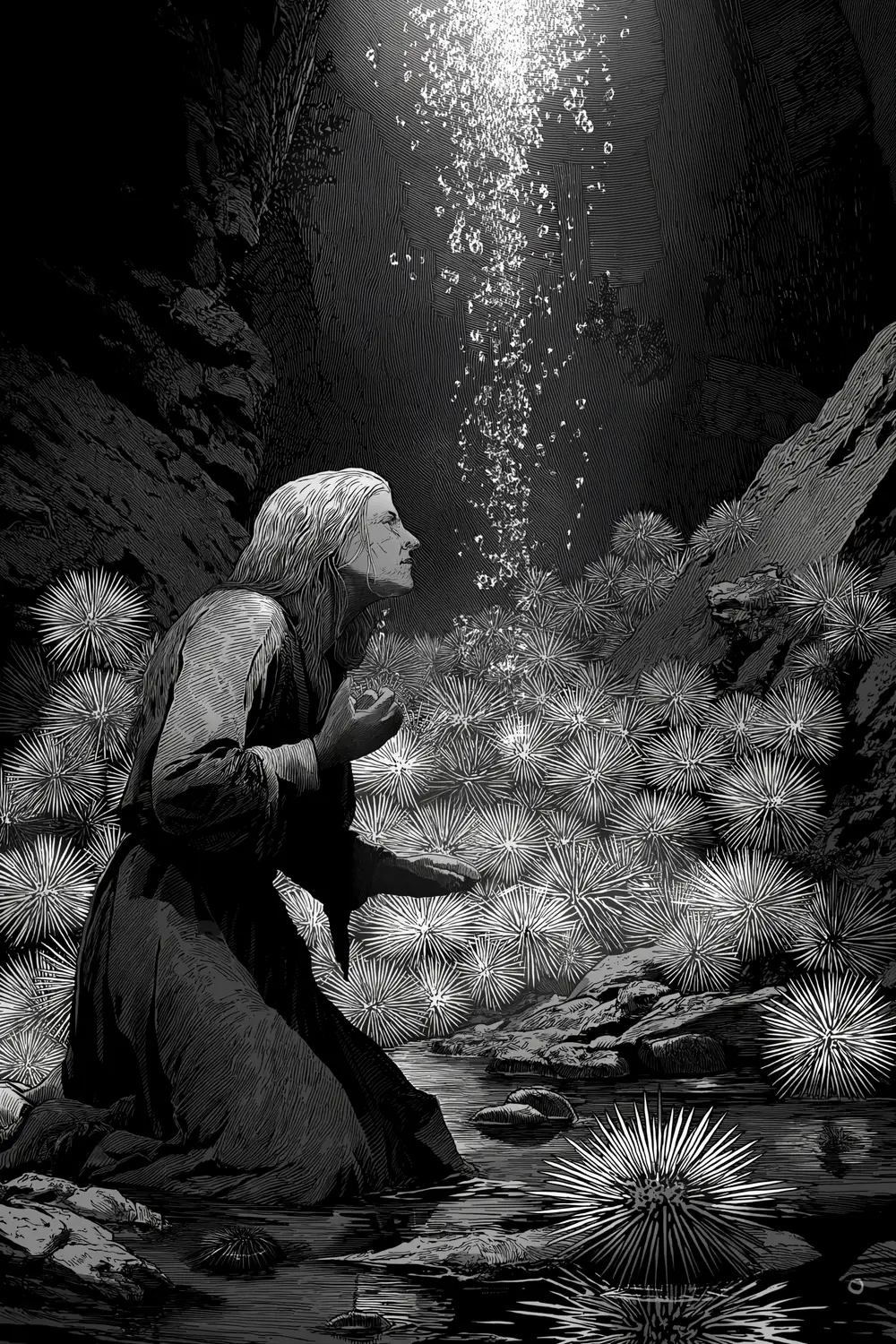
The humid dark was scored by an orchestra of urchins crinkling their spines together as they settled into the water. She sat before the pool as an audience of one. Her right eye was blind in the dark, but her left eye saw the entangled glow of the creatures as they moved over and under each other. She focused on the nearest individual, found the play of its mind circling the mouth and stretching down each searching spine.
She held Scarecrow in one hand and tapped on it with the fingers of her other.
Each tap initiated piezoelectric fields from within the glass, which she made overlap with each other until they matched the patterns of the fields emanating from the urchins.
She tuned in to the switches and gates and circuits that the creature used to move and feel and understand. An application of a simple pressure on the senses told the urchin that there was an irresistible source of food lying deeper within the cavern. Another touch told it that its companions were not as stressed and panicked as it had previously assessed. Another, and it realised that it was, in fact, alone. It could enjoy a wide berth of space and, if it hurried, would certainly be the first one to reach the food, a victory that would make the meal taste all the sweeter.
Sayadaw, as drum major, led her band to march up to the face of the cave-in and assemble on a space slightly larger in circumference than the guard of a sword. There, they could gorge themselves on the most delicious meal of lightly-rotted chalkwillow they had ever had until they were too injured to continue. At that point, they would gracefully roll to the side and pass the meal along to a fresher set of jaws.
When she saw that the swarm had detected the sharp tang of metal in the water, she directed them to chew in that direction.
Slowly but surely, molecule by molecule, the substance of Foldbrjóta revealed itself. It took the work of hours for the urchins to gnaw it loose. They wedged themselves under the sword in the hollow they had made. With careful coordination, they could pass it from delicate foot to delicate foot all the way back to Sayadaw.
But Sayadaw had her sights set further into the cave. The sword was what the Judge wanted, but her personal plans required her to find the crown.
She felt the smell of bloated human remains in the water, which was a different sensation on the feet of the urchins than it would have been on her nose.
To a person, the scent of death is immediately alarming, an urgency propelled by disgust. But the urchins had no interest in meat of any kind, so Sayadaw had to continually replace that disinterest with a different emotion.
Along every inch of the way she insisted to each idiot child-foot on each urchin, again and again, that the taste of rotting meat was exactly the same as the taste of rotting wood. When, at last, the cave-in was breached, Sayadaw strained the tiny eyes on the end of each tube foot to look for the pale fluorescence emitted by the crown. She convinced them that it was the blessed light of day, the sun rising behind the surface of the water.
The real sun was beginning to fall in the sky.
Sayadaw had been sitting rigid on the floor of the cave for eight hours. On the hike up to the cave, she had wolfed down the lunch of dried figs and tabouleh dumplings that Ozige had packed for her. Now she was shivering from hunger despite the heat. She had sweat through her clothes and had bundled them into a stinking ball beside her. Her bare feet were submerged in the filthy saltwater, which had been a coolant in the first hour but had since heated above the temperature of her blood. Her face was cramped from squinting through her eyepiece.
Her entire body would ache if she allowed herself to feel it, but she was hypnotised by the rhythm of the million tube feet: roll, stretch, feel, adhere, roll, over and over.
She scarcely registered when the urchins at last found something.
They conveyed it, haltingly, over a carpet of their bodies, towards her.
At last, the hilt of Foldbrjóta emerged from the fist-sized hole and the sea urchins presented it to her. This Sword had been the conclusion of wars and the dream of an empire, but to Sayadaw, it looked comical, like a stick inelegantly held in a dog’s mouth. Blinded by sweat and exhaustion, she took the sword from the cortege, set it down on the pile of her clothes, grit her teeth and concentrated on bringing the crown out next.
The sun began to set when the first corner of the crown’s fabric peeked through the borehole. She let out a raspy shout of triumph, abruptly stood, and was about to wade through the thicket of urchins to grab it with her own hands before reason intruded and she stopped herself. Her body was in agony.
The urchins stopped, confused.
Sayadaq collected herself and began tapping on the surface of Scarecrow again when Kader stepped through the wall and picked up the sword from the wet heap she’d left it on.
Sayadaw turned her head so quickly that her eyepiece fell to the floor. She could only make out the outline of Kader’s silhouette in the gloom. All at once, she tried to shout, to object, to attack. By outrage alone she would put the fully armoured warrior in her place.
She lurched one step forward and Kader took one step back, melting into the wall. The sword was gone.
She had no time to scream. She fumbled at her feet for her eyepiece, fastened it to her face, then pelted up the passageway that led outside. In her haste, she stepped on more than one urchin, spines snapping off in her feet along with a drop of venom, but her fury was undeterred. All she needed was to catch sight of a single heartbeat, a single impulse from Kader’s nerves, and she would dog the thief to the ends of the world.
The homunculus of the Judge was standing at the mouth of the cave, a purple shadow in the dying light. It asked her, in that approximation of a voice, what the situation was.
Sayadaw, her reserves of wit and cunning depleted, only howled, and the homunculus came to the reasonable conclusion that the mission was a failure.
It rose in the air, held afloat by the ring it wore as a belt, and Sayadaw saw the supports of her world falling around her.
The homunculus would report her failure to the Judge. Her badge of the Reliquary would be retired. They would take her eyepiece; a loss equal to the plucking of her actual eyeball. She would be excommunicated from the Order of Power. Ozige would be struck down by disappointment and shame. The Order of Power would mobilise against the Archive, and when they cracked open its secrets they would fall upon the Library like a thunderbolt.
Nothing would remain of Sayadaw’s past, her home, or her future.
She watched in horror as the homunculus flew towards the South. There was no time for finesse. She clawed at her amulet, ensnared the mind of the griffon bird and used it as a missile to swat the homunculus to the ground.
She padded over to the stunned brownie on swollen feet.
It lay in the dust beside the large carrion bird, which twitched its broken wings as it fitted on its back. Sayadaw took the homunculus from the ground, removed the ring from its waist, and wrung the abomination out like a wet cloth.
She took it back into the cave and tossed it to the urchins and then stared into nothing as she advised them to devour the remains.
The swarm shuffled the crown over to her, seeming embarrassed.
She held it loosely in her hand and released the urchins. They were free now. They could die here in the cave along with the scores of their worn-out siblings. They could die along with the hunter she had taken the crown from, along with her entire vision of herself and her career.
She slipped the crown on her head, dressed in her sodden clothes, and limped outside. The air was cool and the roof of the sky was impossibly tall. She had to find a new way forward.
But the crown she now wore could find anything and she had a head start.