
Recovered from a water-damaged folio wedged behind the Banner Registry shelves in the Guild’s eastern annex, this fragment is a single chapter from the seminal work known as “The Painter.”
The complete manuscript of “The Painter” reportedly circulates among private collectors and forgotten library vaults—available to those persistent enough to trace its path. If you are here now, reading this excerpt, it is likely that the larger manuscript is somewhere nearby.
This particular chapter’s separation from the whole suggests deliberate preservation, as references to “the Stranger” align with at least seven independent sources from the period. Whether this indicates a single historical figure or recurring mythic motif remains disputed. For my part, having studied both the fragment and the whole, I believe Lohmen the illuminator was quite real—his quest to paint the twenty-five thousand banners merely the surface of a deeper search.
Editorial liberties have been taken where water damage rendered the original illegible.
His path followed the southern coast—through the rugged lowland realm of Lukos before starting upland toward Zelzel-Mog and Likali. Those two realms intersected at Saltbane Point, a hazard-laden stretch of water that had claimed skilled mariners who sailed too close.
That account had come from a chatty barmaid at the Long Shot Tavern in bek-Rim. bek-Rim was set inland at the end of a long inlet and looked like a quaint little fishing town, though its banner had three weapons.
In truth, it was a quaint little fishing town with a booming industry of destruction nestled within.
Lohmen painted the Banner of Trident Catapult Morning Star on a green field with black trim into his tome of census. As the barmaid told it, large timbers from the surrounding forests were worked and formed to make the catapults sought by armies from all over the continent. The sage snapper Lohmen ordered didn’t last as long as the oral history from the barmaid, but Lohmen found the story captivating.
With a full belly and a new tale to think about on his travels, Lohmen left and was back to illumination.
It must be close. She said it was in the valley around here.
Lohmen trotted along the dusty trail, and a town—of sorts—came out of hiding behind a ridge. Just like the barmaid in bek-Rim had promised, Kisilimli wasn’t so much a town but more of a campsite.
The inland village was comprised of a stunningly broad collection of yurts that could only be fully appreciated by soaring birds. His subject, the Banner of Fire Horse Fire, waved at him from a thick standard driven into the ground. Were it not for that, the place wouldn’t have had a definitive entrance at all.
“Hello!” said a happy child as Lohmen approached. The boy looked to be around nine or ten years old.
“Hello,” Lohmen said. “I believe I’ve arrived at the House of Fire Horse Fire. Is that correct?”
“Yes! Though we name ourselves Horse Two-Fires.” The young boy inspected Lohmen, his horse, and his bags as they exchanged pleasantries. “Are you a Painter?”
“Sort of, I suppose. But when you illustrate a book like this, you’re an illuminator. This is an ancient house, right?” Lohmen recalled reading about the ancient Banners as a child. Any houses bearing only animals and items of the earth were the oldest houses, and some even had a history dating back thousands of years.
“Yes, sir. It’s been here since the Strangers and long before the mythical or weapon houses.” The boy’s face crumpled in disapproval as he mentioned the more modern banners.
Lohmen recognized that look. Kahriah had the same disdain for the Houses of the Sixteen Orders. He started, “My wife feels the same way. She . . . .”
“Is she with you, too?” The question came before Lohmen could finish.
The childlike innocence cut through him like a dagger.
He cleared his throat. “Just me today. But say, I’d like to paint your Banner in my book if that’s all right?” Then he added, “And I’ll be sure to mark its ancient status.”
“Illuminate, you mean,” the boy said with a grin.
Lohmen smiled, but then reminded himself of warnings about keeping the tome hidden.
He’s just a boy.
“Make sure to capture the pride of the horse,” the boy added, looking excited. “I will inspect your work when you’re done if you like.” The boy was delightfully precocious.
Lohmen took a deep breath through his nose to abate emotion. “Who should I ask for when I’m done?” Lohmen forced a smile despite his roiling feelings.
“My name is MoShar.”
Before Lohmen could say anything else, the boy took off with a pack of other children, who were darting through the yurts.
The house of Fire Horse Fire was his first ancient Banner and, given its place on the standard, the first one he could see up close. There was no wear or fray. He tried to recall the previous thirty banners he’d painted, but they had been hung much higher on town and city gates, making it hard to see such details. He didn’t remember seeing any wear or age, and it hadn’t become apparent until he ran one through his fingers.
Peculiar.
With no stones or gates to rest upon, Lohmen sat cross-legged in front of the standard and prepared his tools. An hour later, he lowered his brush and blew softly onto the tome and its thirty-first addition. He smiled proudly before picking up the brush and adding one more feature to the horse: a slight bend in his brow to signify the determined pride that MoShar had required.
Even with a well-defined subject, he found ways to infuse his imagination and talent. The pure satisfaction of his work never lasted long—it was always quick to turn into sheepish approval laced with shame for letting himself enjoy something.
While waiting for his work to dry, he did some basic arithmetic in his head. This was banner thirty-one of twenty-five thousand. I’ve been on the road for six days, meaning . . . it will take . . . five thousand days to paint them all? . . . That can’t be right.
Still, he now had a sample, which was slower than he had initially estimated. Tomeera had said there was no time to waste, but it hardly made sense to rush such a great task.
He pondered her haste while he closed the tome and slid it safely back into his tomesack. Lohmen had settled into an old routine: reconnaissance under the guise of dining post-illumination.
Every banner is one step closer to Thesdon.
And Kahriah.
And Tolo.
Since Lohmen had packed all his belongings and broken the tether, the commission was an opportunity for him. It was a chance to search the world for his loved ones. It was a means to the end, but even still, he found himself wondering what would happen if he veered from his course.
If I deviate, what’ll become of me? Will they send that mute ranger to twirl his dagger in front of me and set me back to task?
It was another question for a man with too few answers.
The community didn’t have a book binder, a tavern, nor any discernible buildings—it only had the circles of yurts. They were arranged around a massive, fountain-like structure that would look at home in even the grandest of cities. It wasn’t carved from marble or twilight quartz but made from countless stones of varying sizes, skillfully arranged into a communal structure. And it wasn’t water in the fountain; it was fire. Not a giant inferno, but a collection of many low fires burning independently of each other.
Built into the circular structure were several inlets, furnished with everything from metal grates to flat rocks and spits, all ready to roast the spoils of a successful hunt or harvest.
Strewn around the fire-fountain, thick stumps of wood were used as chairs and tables. Beyond the stumps, a set of posts were driven into the ground with short pieces lashed across them. Lohmen saw that a horse was tied to one on the opposite side of the fire-fountain and did the same with his own.
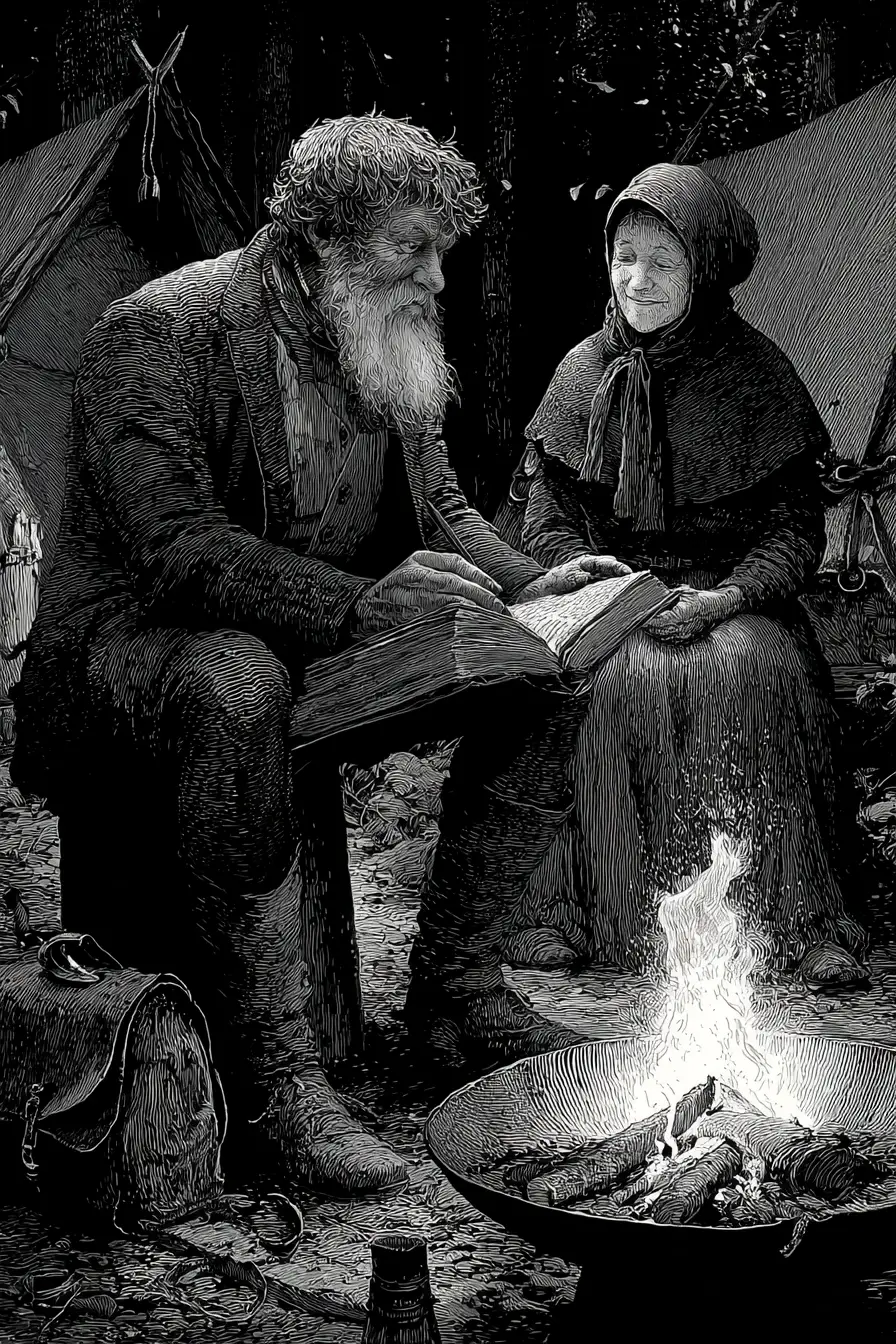
An old woman, sitting by herself on a stump near the fire, caught Lohmen’s eye and gestured to the seat beside her. She smiled as he sat, placing his tomesack in his lap.
“I’m Lohmen,” he said.
“It is nice to meet you, Lohmen. I am Shar.”
“Kisilimli is beautiful. I’ve never seen anything like this place.”
The woman smiled in response, her wise eyes disappearing under old skin.
Lohmen dispensed with the pleasantries. “In truth, I’m looking for my son. He disappeared five years ago in Umlom. Do you remember hearing of it?”
“Five years is a long time, child,” she said slowly. “Why do you only search now? Umlom is not far.”
“It’s a long story.”
“I see. I did not hear of a missing boy, but I will ask my cousins in the house of Three Fires. They live quite far, but we have the means to converse.”
“What kind of means?” Lohmen was genuinely curious.
“I cannot say, nor would you understand if I did.” She went on. “When you come upon a house of fire, ask for news of Umlom, and they will tell you if there is anything to know.”
Lohmen pondered this but wasn’t convinced.
Shar picked up his scepticism and laughed. “We cannot see visions in flames, Lohmen. Do not worry. Though we are an ancient people, we were not the first. We are descendants of the house of Three Fires. It has existed since creation itself. As you might know, they live on a Continent of Detection, but that is a more modern name.”
Lohmen wondered how a story that began at the dawn of time could help him find Thesdon, but he paid attention to learn more about conversing over great distances.
“The Three Fires have burned since the beginning and were lit by the sun itself.” Pride in their history beamed through her voice. “One day, a thousand years ago, there was a violent tempest. It raged hard but was not long. When the clouds cleared, a flame had been snuffed for the first time. The same day, they found a Stranger washed up on the shore. He had no clothes, no weapons or possessions. Not even a name. The Three Fires took the Stranger in and treated him as one of their own.”
Despite himself, Lohmen found himself leaning forward.
“But the third flame would not light,” the old lady continued. “The Flame-keepers tried different woods. Different oils. They tried praying to the sun gods. Nothing would relight the third flame.”
Lohmen looked up as a boy brought a large dish of meat and root vegetables, and Shar offered some to Lohmen.
“The Stranger stayed with the Three Flames, though many believed the extinguished fire was his fault. Soon they came to blame him for any misfortunes that befell the village. ‘What else could it be?’ they thought.”
Lohmen forced himself to chew, realizing he’d forgotten to do so as the tale continued.
“Then, one day, a brave little girl dove into the waters near his landing and retrieved a bag from the seafloor. She brought it to the inner fire and showed it to the Flame-keepers. They did not know what to make of it, but the Stranger saw it and told them it belonged to him. He did not know why; he only knew they were his. They allowed him to dress in its contents. They fit as if they were made just for him when he put them on. The third flame re-ignited when he hung his blade on his belt.”
Lohmen smiled as he ate but failed to see any relevance to his initial question: Where was his son?
“The Stranger had become one of the people, received the kiss of the coals, and stayed for a time. When dressed in the things from the bag of the sea, he developed strange new abilities. That was when we learned to communicate over distances both great and short.” She coughed and set her food aside. “But the Stranger did not stay. The world beckoned him. Some people travelled with him as he crossed the realms. Some settled along the way. That is how we are here.” She smiled.
“That’s very interesting. I look forward to visiting the house of Three Fires someday.”
She hardened her gaze.
“You do not listen, Lohmen. They were searching for answers at the flame itself. Just like you search for clues and disturb the meals of old women.”
Lohmen took another bite and thought. But they didn’t know they were looking for a bag; the girl just happened upon it. And still, there was no answer to his question.
The old woman coughed again. “If they had searched where the Stranger landed as the girl did, they’d have lit the third flame more quickly. Where did your mystery start, Lohmen?” Her face softened as she leaned back.
Lohmen stopped chewing again, mouth gaping open. How did she do that?
“I told you that you wouldn’t understand,” she said.
Lohmen sat silently and ate, trying not to think anything ill of the woman. He thought of his son and the years he had spent looking before the commission letters.
“Maybe you have more than one mystery,” she deduced.
He thanked her and stood. She refused his offer of coin, and the boy who had brought the food was nowhere to be found. Lohmen walked to the fire and picked up a cold piece of charcoal that sat well away from the flames.
On a page torn from his cartography notebook, he sketched the harmonious scene at the fire fountain, making sure to place the old woman in the foreground, wise and smiling. He tossed the notebook in his cantle bag. After scribbling his initials at the bottom of the page, he handed her the piece.
“I will cherish this, Lohmen,” she said when he gave it to her. “Thank you. May the fire be your friend.”
He nodded and left her to finish the meal. Someone cleared their throat near the woman. MoShar looked at him with raised eyebrows.
“Right, of course!” He pulled out the tome and held it on display for inspection.
“Very good,” MoShar said. “I like how you captured the eyes. Where will you go now, Paint—um, Illuminator?” the boy asked.
Lohmen smiled at him with sad eyes before stowing the tome away. The question hung on him for a moment before he answered. “I’m not entirely sure yet, but I’m going to see a book binder about some paper. I’m going to search at the start.”